Showing posts with label eating disorder recovery. Show all posts

Sunday, 26 January 2014

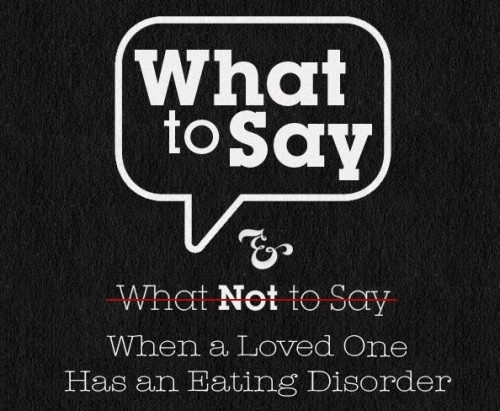
What to say when a loved one has an eating disorder


1. Don’t make valued body judgments
Example sentences:
  • “You look great as you are!”
  • “But you are already thin.”
  • “You look healthy!”
  • “You’re not fat.”
  • “REAL women have curves!”
  • “You don’t want to look emaciated, you want to look buff/toned!”
Why you might want to say it:
  • “Eating disorders happen because people are insecure about how they look… so if I compliment them, they’ll be less insecure, and feel better!’
Why you shouldn’t:
  • Eating disorders are about taking every insecurity and translating it into terms of food/weight/appearance, making appearance insecurity mostly a symptom of a larger problem rather than the whole problem itself. In addition, the accidental message being sent is that an eating disorder is only bad if the person is already thin — and so if that person was fat, their eating disorder would “make sense,” not be as much of a problem, or not bad enough to need help.
What to say instead:
  • Focus on things that don’t depend on weight — activities that they are good at, positive character traits, and occasionally weight-independent physical characteristics
  • “Look how strong you are now!”
  • “You’re much more active/aware/fun to be around since you’ve recovered.”
  • “I like you because you are a great friend.”
  • “You look a lot happier since you’ve recovered.”
  • “Losing or gaining weight won’t change how I feel about you — I love you for who you are, not how you look.”
2. Don’t make it about your issues or insecurities
Example sentences:
  • “If you think YOU’RE fat, you must think I’M obese!”
  • “If you loved me, you would eat more.”
  • “If you won’t eat, then I won’t eat either.”
  • “I know how you feel.”
  • “Are you trying to punish me for something?”
  • “I’m sorry.”
Why you might want to say it:
  • “Love conquers all! Maybe they don’t like themselves enough to recover, but if I make it about me, then they’ll choose to recover for me.”
  • Many people want to say “I know how you feel” or “I’m sorry” out of genuine desire to empathize and help. And while they are more helpful than many of the others, the fact of the matter is that you CAN’T really know how they feel, because you’re not them, and it’s not your fault, so your “sorry” doesn’t really mean anything.
Why you shouldn’t:
  • Eating disorders are an illness, and they are not about hurting anyone else; they are a way to cope with otherwise overwhelming things (depression, anxiety, abuse, trauma, etc.).Heaping more blame on a sick person, and making them focus on you and your discomfort will only make them feel more guilt and shame, making recovery even more difficult. The likely outcome will probably be that they will stop seeing you as a safe ally, and instead feel the increased need to lie or hide things from you in order to not hurt you. This isolates them further, and keeps you from actually being able to be there for them in an effective way.
What to say instead:
  • “I am here for you, because I care about you.”
  • “How can I best support you?”
3. Don’t call attention to what/how much they’re eating
Example sentences:
  • “OMG you’re actually eating!!”
  • “You’re eating again, so I guess you’re recovered!”
  • “You’ll eat THAT, but you won’t eat ___?”
  • “You’re eating a lot… are you going to puke it up later?”
  • “That must be at least ____ calories!” / “Do you know how much fat/carbs/sodium is in that??”
Why you might want to say it:
  • For some of these, well-meaning people might say it as a way to point out progress in recovery, or to make a serious situation a little more lighthearted, or just genuine curiosity. For others, I can only guess that they just weren’t thinking at all.
Why you shouldn’t:
  • Eating disorders are toxic because of obsession; part of recovery is learning to do normal things without obsessing about them or paying them undue attention. When you call attention to something we really need to think less about, it is very triggering and almost universally unhelpful.
What to say instead:
  • “I’m proud of you for all the progress you’ve made in recovery.”
  • “Great job, honey. So how’s that [insert unrelated project] of yours coming along?”
4. DO NOT brush it off, or downplay the severity
Example sentences:
  • “It’s just a phase.”
  • “It’s not that bad.”
  • “You’re not really sick.”
  • “Other people are sicker/starving in China/etc.”
  • “It’s just an extreme diet.”
  • “I know how you feel, dieting is really stressful.”
Why you might want to say it:
  • “It’s just a negative attention-getting tactic; if I don’t reward it, they’ll drop the act.”
  • “I used to have a ‘phase’ like that, and I got over it, so they will, too.”
Why you shouldn’t:
  • If someone trusts you enough to open up about something they’re really struggling with, it is completely invalidating to brush it off as nothing. If you are one of the first people they open up to about something, and you react in this way, it could very well discourage them from getting the help they might desperately need, perhaps until it’s too late.
  • Each experience with disordered eating is different. It could very well be just a “dieting” phase for some people, but it is also the deadliest mental illness for a reason — because for some people, it is much more serious.
What to say instead:
  • Try to reflect back the amount of seriousness that they are bringing to the table. Note that this means you have to listen to nonverbal cues and take into account their personality/confrontational style. If it seems like they are getting something heavy off their chest by telling you this, it is a sign that this means a great deal to them, and that what they are looking for from you is to address that it is a struggle and to offer them support. If they mention a-little-too-casually that they have been dieting a lot recently, try asking more conversational questions that could help them open up a little more about what they’re going through.
  • “It sounds like this is weighing heavily on you. Do you want to talk about it?”
  • “ ‘dieting a lot,’? What do you mean?”
5. Do NOT offer or ask for dieting tips. Don’t talk about dieting at all.
Example sentences:
  • “If you REALLY wanted to lose weight…”
  • “So-and-so lost ___ lbs on such-and-such diet.”
  • “I read about this diet in [insert notoriously fat-shaming magazine]…”
Why you might want to say it:
  • It’s become a kind of way for women to bond with other women, and just for people to talk idly about in general. Cultural pressure has almost literally everyone worried about their weight and so it’s common ground for almost everyone else, which makes it very accessible as personalized small talk. Mostly people just say this kind of stuff because they aren’t really familiar with the profound consequences it has on some people.
Why you shouldn’t:
  • Self-comparison is incredibly addictive and very unhealthy, especially for those with eating disorders. Statements like this are like throwing wood on a fire and then dumping the contents of a gasoline truck onto it.
  • Implying that they should focus on losing weight is terrible. It’s kind of exactly opposite all the goals of recovery.
What to say instead:
  • anything else. Seriously.
6. Don’t blame them for being sick
Example sentences:
  • “Snap out of it!”
  • “Stop feeling sorry for yourself.”
  • “Just eat something already, jeez.”
  • “Why are you making this so hard on me/everyone else?”
  • “You’re being really selfish.”
Why you might want to say it:
  • Frustration, largely, with an issue that you don’t really understand that doesn’t seem to be making the consistent progress you’d want.
  • Wanting to “shake them out of it”
Why you shouldn’t:
  • It doesn’t work
  • It reinforces guilt, blame, the idea that there is something wrong with them, etc. It also sets the expectation that they can just “snap out of it,” (when clearly they can’t, or they certainly would have by now), and when those expectations are internalized and then not met, it’s even more “justification” for the low self-esteem and low sense of self-worth that are major barriers to recovery.
What to say instead
  • “I know that this is very frustrating for you. Remember that I care about you a lot and I am here in whatever capacity I can be.
  • You might also want to say nothing and take a breather until you can rejoin the fray. Being a supporter of someone with a chronic illness, especially a chronic “invisible” illness, is extremely draining and can have serious effects for the people around the suffer as well as the sufferer themself. If you need a few days off in order to clear your head and regain your balance, that is more than fine. Your number one job is to take care of yourself; only when you are really addressing your own needs can you actually be helpful to others. If you need to explain this to your loved one with an eating disorder, reassure them that you still care deeply about them, and you still want to help, but that you need some time to take care of yourself for a while. Try to make sure that they recognize that they have other people in their support network that they can lean on if necessary, that you’re not abandoning them to their own devices. Emphasize that it is not their fault, just that you have your own affairs you need to get in order. Establish exactly what kind of relationship they can expect from you in the meantime — no contact? emergency contact? just friends? no difference in label, just less time/emotional availability? Agree on expectations (both yours of them and theirs of you) and things will hopefully go much more smoothly. But whatever happens, again, your first responsibility is to take care of yourself and you are NOT a bad person if you ultimately have to withdraw from a position as supporter in order to do so.

Friday, 24 January 2014

Please eat

Please eat, imagine if in 30 years time you're still living with this horrible illness because you didn't make the decision to recover now. Eat that cake and buttery toast before bedtime, have a milky hot chocolate with melted marshmallows in it because although those things seem very significant now, in the bigger picutre they're really not. In 30 years time you won't even remember eating the 'scary foods' but what you will remember is spending what's meant to be the best years of your life worrying about grams of fat, sugar and calories.

Tuesday, 7 January 2014

New Year’s resolutions of the unknown

Now, as the new year has arrived, the stores are filled with weight loss products, the TV shows more weight loss commercials than the actual TV program, the magazines are full of tips on how to lose weight and etc. etc. etc. This will last through whole January, in February it will slow down a lot because people have simply given up on those unreachable and pardon my language: stupid resolutions they set for themselves in hope that the New Year will magically bring all that is needed to fulfill those resolutions. They don’t work for it, or well, they do buy bunch of dieting products thinking that that will magically make them ‘skinny’, and in few, if not none of the cases does it work.

I am annoyed by those ads that only are there to fool people to waste their money on as pointless, unnecessary dieting products. And what does it do for us, other than making us feel bad about ourselves? I don’t really know. But I know that it is triggering as hell having to go to the pharmacy to buy supplement drinks (none dietary) to actually drink WITH food, and the first thing you see is a mountain of diet supplements saying you should drink them INSTEAD of food. Is it just me, or has this become a real problem in today’s civilization?

The hottest thing today is to drink something, that you actually don’t know what is (other than it contains x calories), instead of eating real, healthy, satisfying food. Can you believe it? Are we that lazy and desperate to lose weight?

I’m going to be honest and say that I have been very tempted to buy those things, even now in recovery, because it says that you can easily lose x kg within 2 months. My mind tells me: “oh perfect! “ But hey, I need all the nutrients I am getting from eating the amount I am eating. I need those proteins, I need those carbs, I need those fats, I need those vitamins and I need those calories! My body doesn’t work without them, and neither does any other body.

Drinking those drinks doesn’t magically fix the problem you have with yourself. It won’t make you feel any better about yourself. It doesn’t make you prettier or more perfect. And it doesn’t make you more important than you ever were before. (You are more important than you think, and you will never become less or more important than that! You are as important as it is possible to be and ever become!) It doesn’t fix a thing. Not even for people those are obese. It won’t make them happier; it won’t boost their self-esteem etc. etc. etc. (I could go on and on and on, but I won’t bore you). All those things come from the inside. Even though the messages you get from the ads are that you become happier, prettier and healthier. That is bullshit and nothing but bullshit.

My therapist told me that we have to be critical to ads like that and think about who those ads are actually for. Are they for normal people within healthy weight? No. Are they for slightly overweight people that can easily change their diet to become healthier? No. Are they for us dealing with eating disorders? Hell no.


So why bother to waste money on dietary things you really do not need instead of buying that gorgeous shoes you’ve been looking at for weeks? For me it is an obvious choice.

-M
(no pics in this post as they can be triggering)

Monday, 18 November 2013

I do not need

I do not need
empty stomachs,
shrinking skin,
children’s clothing,
or dropping numbers;
I do not need
icy hands,
sunken eyes,
falling hair,
or jutting bones;
I do not need
distant thoughts,
blacked out vision,
hospital beds,
or a dying pulse.
I do not need validation:

I do not need
to die again
to be deserving of
coming back to life.

Thursday, 14 November 2013

Day 22

Describe your goals for your future. 
I want to be happy. I want to be healthy. At the moment, that are my main goals, because if I'm happy AND healthy I can do mostly anything I can ever dream of. I want to be able to go to a university in England, live in a big city, travel, have kids, adopt a kid, have enough money to take my kids on a huge trip to africa for a year, homeschool them while I work as a vulenteer and etc etc and etc. Those are my dreams, something I work towards in life, but as you can see, those dreams won't happen for the next 3 years or so, but I can work towards them, right?
My short time goals are: 

  • Be able to travel to Germany or Scotland with my class (I didn't get to go to the Netherlands with them) 
  • Be able to enjoy the time I get in February with my ultimate worlds best friend. He is coming to visit me and I am so excited!!! 
  • Be able to travel to Tenerife with my family in the Easters 2014, AND enjoy it! 
  • Get mostly A's in school (only few B's are allowed ;) ) 
Dream


Wednesday, 13 November 2013

I'm freezing my ass off right now. I'm so cold that I can't even do schoolwork. I'm laying besides the radiator, and still am I freezing. What is up with that?
I love wintertime, but I don't look forward to this winter weather wise... I'm freezing now and it is +degrees outside, how will it be when the temperature is around -10 or even -20 degrees? Yeah, I know what you're thinking. I'll die!

I'm staying home from school today because I am in a huge relapse and I really have to use all my time and efforts to get back on track. I hate this stupid, annoying, hating, terrifying disorder. I want to be free,  free like a bird!

There is no one else than me, myself and I, I have to recover for. I have to recover because I want to, not because others want me too. Even though that's a big plus, I won't be able to recover if I don't want to myself. I can wish all I want, but wishing isn't enough. I have to put those wishes into actions. And if I want to be able to put those wishes into actions, I have to put all my time and efforts into it.

I want to gain my life back. I want to enjoy life and enjoy living. I am sick and tired of this so called 'life'. I want to be normal, once in for all. Even though I'll never be completely normal (if there is such a thing) I want to be a little closer to it than 500000000 miles away like I am now.

Why does this have to be so hard?
I'm finally getting a specialist to talk to, and I'll meet her on Tuesday. I deeply hope that it will work because I am desperate. I need to be able to concur this illness. It has taken up way too much of my life!

Tuesday, 5 November 2013

Day 18

Here’s a challenge. Come up with a hobby you’ve never done or haven’t done in a while that has NOTHING to do with eating or exercising or cooking. Totally non eating disorder related. What is your hobby? Why did you choose it?

Horse-riding. I didn’t choose it because of the exercise, and I’ve never ridden with the thought of “exercise” in my head, but because when I’m riding I feel completely free, ED and mental illness free, and I LOVE it! 


Have you ever seen such a beautiful horse as this one? Nope, that's what I thought. I am a proud owner of this stallion and he's just perfect! The man in the first photo is my grandpa btw :) 

Monday, 4 November 2013

Day 16

How would you help a close friend or family member if they developed an eating disorder?

 I have a close friend dealing with an ED and I try to be there for her as much as I can. I reassure her constantly that she is more than good enough, that her body needs fuel, and that there is more in this world than calories, food and over-exercise. I can’t fight her battles for her, but I can be a true friend and be there for her as much as I can. 

Thursday, 31 October 2013

Day 12

Post 1 thing you've aten today

This was my lunch. Two toasts. One with butter (!), ham(!), cheese (!) and cucumberslices. The other one with Prime (Norwegian spread that is made of milkproducts) and my daily glass of milk on the side :)
Fearfood Friday? huh, nope, not for me. For me, everyday is a fearfood day!

-M

P.S. this is my Instagram account if you are interested (hint, hint ;) )

Monday, 28 October 2013

Day 10

Does anyone in your close family have an eating disorder? If so, do you think it had an impact on you developing one?

 Yes, my fathers mother has Anorexia as well. And yes I think that had a huge impact on me, especially because when she was at her sickest she kept reminding me that thin was better and when I started losing weight in 5th grade, she gave me a huge compliment and told me that I had been fat and stuff… But she has helped me a lot and this summer she said that we should fight together and the first one to get to 65 kg would get a price hehe. But I don’t know how that is going since she doesn’t really contact me when I’m not visiting her.

Sunday, 27 October 2013

Day 9

 Create a list of all the negative things your eating disorder has given you.
·         Constipation
·         Worse sight and a lazy eye
·         Worse hearing
·         Thin hair
·         Dry skin
·         Lactose intolerance (gotten better)
·         Gluten intolerance (gotten better)
·         Joint pain
·         Chest pain
·         A lot of anxiety against food
·         People are actually scared of talking to me and look and stare a lot
·         Bad concentration
·         Paranoia over small things that don’t really matter
·         I’m too addicted to routines.
·         Exercise addiction
·         Extreme fear of nutrition and water consumption

And I keep counting for a long long time!

Saturday, 26 October 2013

A normal teenager for half a day

Yesterday I was going to restrict. I felt humongous and disgusting, but then I read my favourite blog that always helps me through tough times and motivates me to continue recovery, even when I am about to give up (www.living-with-anorexia.blogspot.com) You should really check out her blog, she's amazing!!
But yeah back to me. Like I said, I read the blog and it motivated me to fight, so what did I do? well, I went down the toughest, stressfulest, hardest stairs I've ever have gone down. It's the same stair as I always walk up and down at least once a day at school, but they've never been this tough to climb. I went to the cantine to buy something to eat. Some REAL food, not diet yoghurt or 0% fat products. REAL wholegrain baguette with a cut up meatball, pickle, onion and mustard dressing (!!) It was so good and I didn't let the guilt sneak up on me. No matter how hard it tried, I didn't let it get to me. And I'm proud!


Later that day, I went to the supermarket with my mom and guess who got her pre ed favourite icecream?! Yes, it was ME! Magnum whitechocolate strawberry icecream. It was DELICIOUS!
Did I restrict after that? Nope. I had dinner wich was wholegrain couscous with a soft egg and mini tomatoes. After that I went out to a party. The first one in over a year! Due to my struggles I haven't been able to party, and nope I don't drink. I don't want to. I don't see anything charming with underage youths drinking with the one mission: drink as much as they can in the shortest possible time. But yeah, I had fun with my friends and actually felt like a normal teenager for once :-D I danced like an idiot and laughed like one as well.


My classmates kept saying how glad they were to see me and asking me if I was having fun. They are amazing and so nice! (they know that I'm struggling)
Yesterday afternoon was really nice and I don't regret a thing!
Over and out
-M xoxo